
Amazon Influencer Tools I’m Still Paying For in 2026 (And Why)
I keep paying for software when it removes a real problem from my work. That is the question I wanted to revisit after Amazon changed enough of the Influencer and Creator Connections experience to make my old tools article feel dated.
This post contains affiliate links. As an Amazon Associate and Walmart Creator, I earn from qualifying purchases. I may also earn a commission through other affiliate programs at no extra cost to you. I only share products I genuinely find useful or interesting.
Not which tools exist. Not which one has the longest feature list. Which ones am I still paying for?
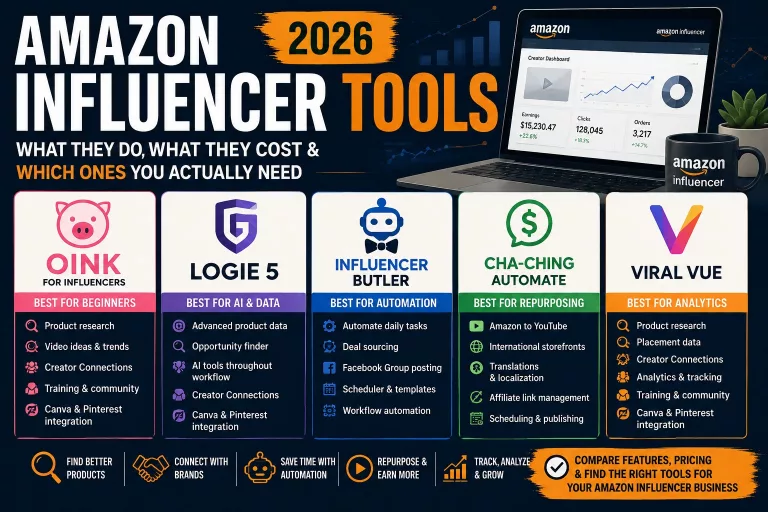
The short answer is Oink, Cha-Ching, and Influencer Butler.
That is not a recommendation that every Amazon Influencer needs three subscriptions. It is an account of the three tools that still solve different problems in my own creator business. If a subscription is not solving a problem you actually have, it is just another monthly charge quietly eating snacks in the corner.
Some links in this article are referral links, which means I may earn a commission or referral credit if you subscribe through them. That does not change what I say about the tools or what I choose to keep paying for.
I went into more detail about the larger field in my original Amazon Influencer tools article. This is the follow-up: what survived the editing process when I looked at the tools I am actually still using. Amazon’s new Global Storefront is one reason this update matters. A new system for international publishing can be helpful, but it can also create a serious migration decision for creators who already have established storefronts and large content libraries.
Oink: my storefront and Creator Connections workhorse
Oink remains the tool I reach for most often when I am working inside my Amazon storefront and Creator Connections.
The browser extension is still my favorite part of it. I like that I can make calls when I explicitly ask it to do something instead of having it constantly scanning in the background while I am trying to do other work. That gives me more control over when the extension is making requests, which matters when Amazon is already capable of making a simple task feel like a negotiation.
That does not mean throttling is impossible. Scheduled scans can still overlap with other active scans, so I am careful about how I set them up. The distinction is that the extension is not just wandering off on its own every few minutes. I have more say in when the work happens.
Oink tracks ASINs across my storefront and scans Creator Connections on a schedule. It can also automatically accept new campaigns or improved campaign opportunities according to the settings I choose. That removes a great deal of repetitive checking from my day without making me pretend that automation does not need supervision.
I particularly like the product-scanning side of Oink. It is practical because it gives me a way to work through a storefront that has become too large for casual memory to manage. The current Oink documentation describes storefront checks for unavailable products, untagged videos, and over-tagged listings, along with Creator Connections cross-checking. In my workflow, that means I can look for products that need attention and opportunities connected to ASINs I already have in my storefront instead of treating the whole catalog as one enormous mystery pile.
Product scanning now also includes bulk posting to my Facebook group. Oink’s feature announcement describes Facebook deal-post generation as a way to turn the product information I am already reviewing into properly formatted group posts. That gives the scanning feature another practical use beyond the Amazon side of the workflow: I can review products and then move a group of relevant deal posts forward without formatting every one from scratch. I am describing the feature at that level because the exact posting workflow still depends on what I ask Oink to do and how I have it configured.
The free course has been genuinely helpful, too. Replays are available after signing up, which is useful because I do not always absorb software training perfectly the first time. Sometimes the first time I am taking notes. The second time I am trying to remember where I put the notes.
Oink earns its subscription for me because it combines storefront housekeeping, Creator Connections monitoring, and product scanning in one place. You can try Oink here with the code ANGEL10. It is not doing the same job as the other two tools in this article.
Cha-Ching: international reach and multichannel publishing
Cha-Ching fills a different gap.
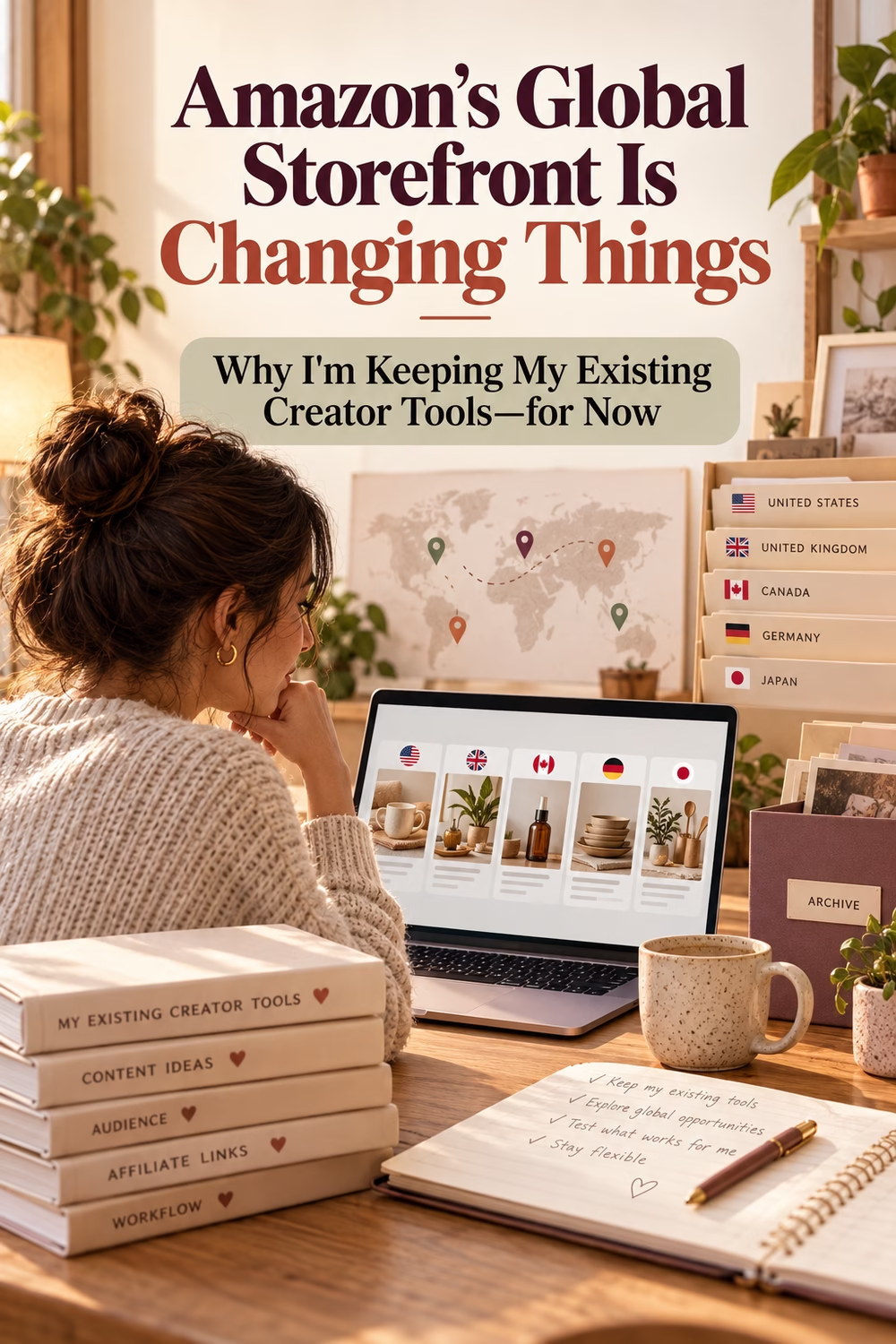
Amazon’s Global Storefront is easier to understand if you separate marketplace availability from account access. Amazon has multiple international marketplaces and lists the Influencer Program in some countries, but that does not mean every creator has the same storefront setup or that every country a creator wants to reach is included in a particular feature. The new Global Storefront rollout covers ten countries, including the United States, while storefronts outside those supported countries remain separate.
I have not received access to the new Global Storefront yet. I already maintain established international storefronts and use Cha-Ching as part of that workflow, so I am not ready to abandon it or merge everything simply because Amazon has started offering a new system. Amazon’s guidance says that supported storefronts can be merged into a primary storefront, that existing content from merged storefronts moves into Archived, and that the merge and primary-country choice are permanent. Amazon also describes restoration options for archived content. With a large content library, that is not necessarily a small housekeeping job.
I have heard concerning reports from creators with large international storefronts, including mixed reports about how international sales look after migration. I am not treating those reports as proof of a program-wide sales problem. I simply want a clearer understanding of what happens to existing content, product placement, commissions, and reporting before I make that decision. My expectation that existing creators may eventually have to adopt the new system is only an expectation, not a confirmed Amazon requirement. For now, I am continuing with the international workflow I know.
Its role has also expanded. I am not paying for it only because of international storefront support anymore. Cha-Ching now has a social-publishing side as well, with support for uploads to Facebook, Instagram, Threads, Pinterest, and TikTok. The exact workflow and availability can depend on the feature and plan, so I am not going to describe every social post as completely automatic. The useful point for me is that the tool gives existing content more places to go.
That matters because the difficult part was already making the video. Once I have spent the time filming, editing, and uploading it to Amazon, I would rather not create an entirely separate administrative project just to reuse that work elsewhere.
Cha-Ching is therefore the distribution tool in this group. Oink helps me manage what is already happening in my storefront and Creator Connections. Cha-Ching helps me get more mileage from content I have already made.
Those are related tasks, but they are not identical tasks. That difference is the reason I have not replaced it with one of the other tools. Cha-Ching Automate is here with the code ANGEL.
Influencer Butler: deals, Benable, and a broader creator ecosystem
Influencer Butler stays in the lineup because its automated deals posting is still the strongest part of the tool for me.
That workflow is largely set-and-forget, with the usual reminder that “set-and-forget” is not a synonym for “never look at it again.” Platforms change. Websites behave strangely. Automations occasionally need attention. I would rather have a tool handle repetitive work than do that work manually forever, but I still want to know what the tool is doing.
I particularly like Benable Butler. It builds niche-relevant Benable lists and can incorporate my other websites, including my blog and Etsy shop. That matters because I am not exclusively an Amazon affiliate. My content and recommendations exist in a broader ecosystem, and the tool is more useful to me when it helps support that ecosystem instead of forcing everything through one platform.
Benable Butler is not a magic button that removes editorial judgment. The tool can help build a list, but I still want to review what is there before treating it as finished. That is a reasonable trade for getting a useful first pass on a niche list without starting at a blank page.
The other reason Influencer Butler remains valuable is the support. Liz provides weekly training calls, listens to user feedback, and responds quickly when bugs appear. I recently suggested an improvement, and Liz incorporated it into related work that was already underway. The improvement became available the following day.
Influencer Butler is here with the code ANGELA.
That tells me something useful about the tool and the person maintaining it. When software is changing along with the platforms it works with, responsive development matters.
Do I really need all three?
I genuinely keep all three because they solve three different problems in my business. That does not mean every creator needs the same combination.
The three tools overlap in places, because software developers have noticed that Amazon Influencers tend to have more than one repetitive task. But their main jobs are still different for me:
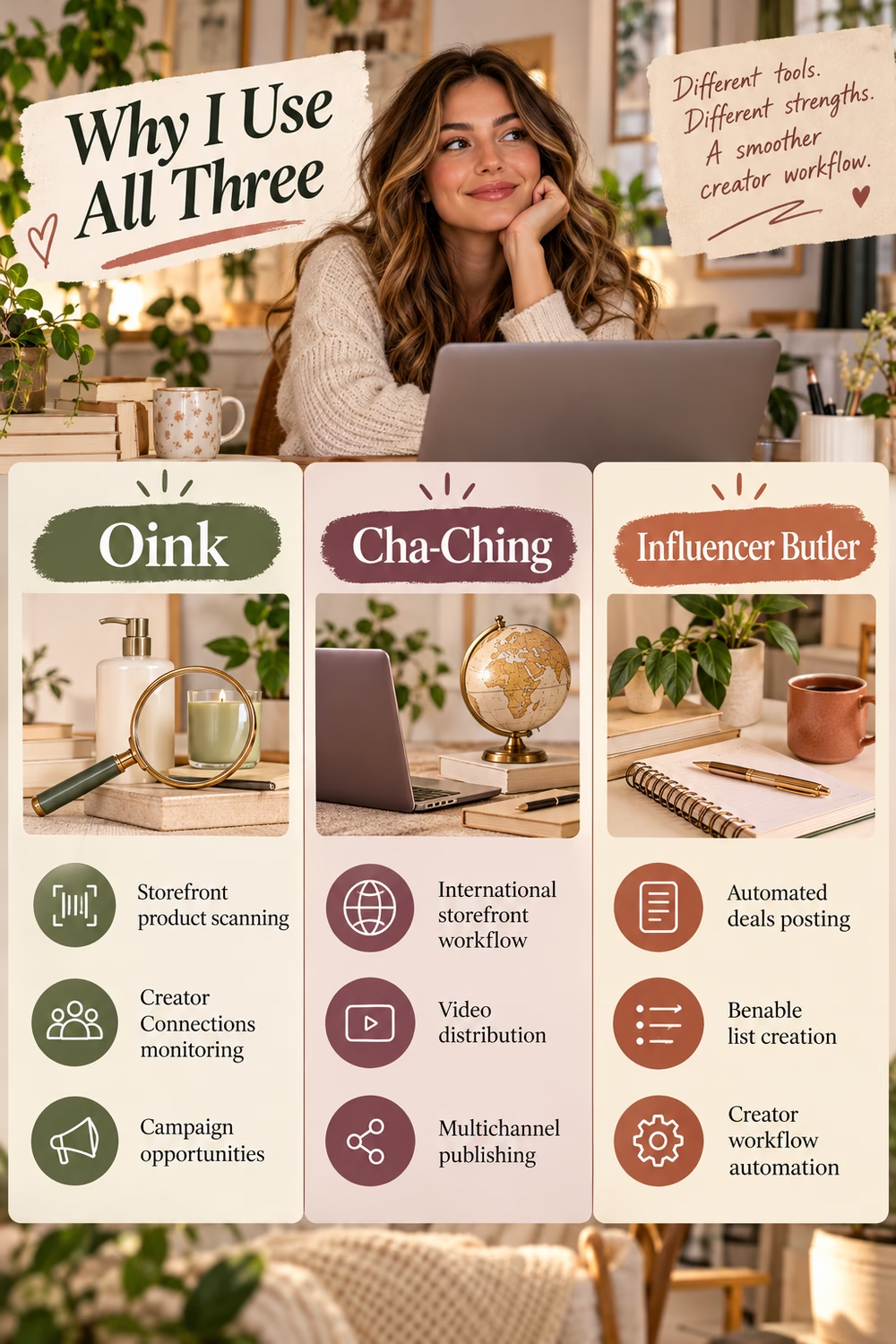
- Oink manages storefront inventory, product scanning, and Creator Connections opportunities.
- Cha-Ching supports international reach and multichannel publishing.
- Influencer Butler automates deals and creates niche-relevant Benable content.
If your workload is small, your content library is new, or your budget is tight, paying for all three would be hard to justify. Start with the problem that is actually consuming your time. You may need one tool. You may need none of them yet.
I also would not measure subscription value only by whether a tool creates more commissions. Sometimes the value is making a necessary task less tedious. Sometimes it is helping me use content I already made. Sometimes it is giving me enough control that I can understand what is happening instead of clicking through another dashboard and hoping for the best.
What Amazon’s changes have taught me
The recent changes have made the work harder to measure cleanly, which makes the question of tool value harder too. If Amazon changes how campaigns are surfaced, how international content is organized, or how reports present activity, then I need to judge a subscription by a concrete workflow benefit I can actually see—not by the promise that it will make more money.
The Global Storefront is a good example. A feature intended to simplify international publishing may eventually reduce manual cross-posting, but it can also create migration work for a creator who already has a substantial library spread across international storefronts. Until I understand that tradeoff, the value of the system I already use includes continuity and control—not just the number of destinations it can reach.
Amazon’s current Creator Connections documentation describes campaign-level reporting with aggregate sales, orders, and clicks. It also describes a 24-hour attribution window and notes that some orders may be attributed even when reported clicks are zero. That is useful information, but it does not make every performance question easy to answer.
I have also experienced a substantial slowdown in offsite sales while my onsite Influencer activity continues. That is my experience, not proof that Amazon is failing to attribute sales. I am careful about that distinction because reporting can be incomplete or difficult to compare without enough account-level information.
The practical result is that third-party tools have to earn their subscriptions through workflow value. I need to know what a tool helps me do, even when the reporting cannot tell me everything that happened to every sale.
Final thoughts
For now, I am continuing to pay for Oink, Cha-Ching, and Influencer Butler because they remain useful in the work I am actually doing. That decision can change as Amazon and the tools change, but these three still earn their places in my workflow today.